FrontRow by Boxlight Technology
Classroom Audio Systems for Instructional Clarity and Campus Communication
Audio infrastructure that distributes a teacher's voice to every listener, integrates with paging and emergency alerts, and supports equitable access for all students.

The Audibility Problem
Children Cannot Listen Like AdultsThe impact of acoustics in K–12 classrooms is almost always underestimated — because adults don't experience the problem themselves. Adult listeners compensate for background noise, fill in missed words from context, and adjust unconsciously to poor room acoustics. Children cannot. Until approximately age 13, the brain structures required for effective listening in noisy environments are not fully developed. Young students are also still building vocabulary and lack the linguistic experience to reconstruct missed words — a task adults perform automatically. Students farthest from the teacher miss up to 40% of spoken instruction. When keeping up requires that much cognitive effort, attention drops, behavior problems follow, and academic performance suffers. | 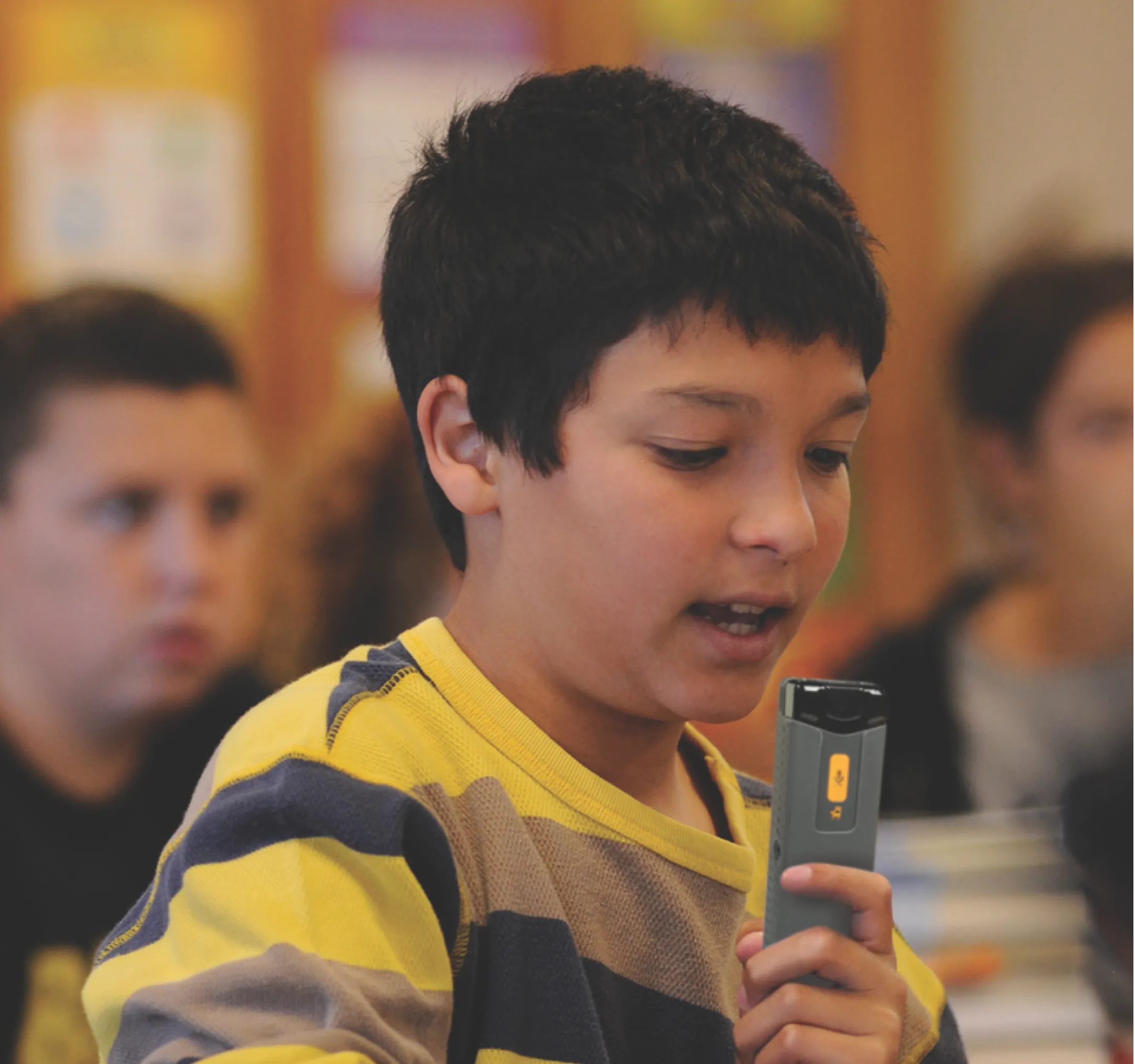 40% of spoken instruction missed by students in the back of a typical classroom without audio distribution |
Who Is Affected
 | More Students Than Most Districts RecognizeInconsistent audibility affects far more than students with diagnosed hearing loss. English learners need clear amplification to absorb language nuances. Students with auditory processing challenges require distortion-free, consistent sound. Neurodiverse learners engage more effectively when audio is predictable. Every student in the back half of the room strains to hear regardless of ability. Classroom audio distribution reaches all of these students simultaneously — without singling anyone out for accommodation. Sound support becomes an environmental condition, not an individual intervention. Teachers benefit equally. Vocal strain from projecting over noise all day is a leading contributor to teacher absenteeism — and a cost most districts never measure. |
If students cannot hear clearly, no other instructional investment — curriculum, professional development, or technology — delivers its full value.
Research-Proven Benefits
One of the Most Researched Investments in Education Technology
Classroom audio distribution is backed by decades of longitudinal research — including the landmark MARRS study (Mainstream Amplification Resource Room Study), a three-year federally recognized project. Few edtech investments can point to this depth and consistency of evidence across student populations, grade levels, and outcomes.
Phonemic DevelopmentStudents receiving phonemic instruction in amplified classrooms scored significantly higher on phonological awareness assessments than those in unamplified settings. Clear audibility of speech sounds is foundational to literacy acquisition — children write as they speak, and they speak as they hear. | Reading & Vocabulary GainsThe MARRS study demonstrated improved scores on standardized tests of listening, language skills, reading, math concepts, and computation. Multiple studies report measurable academic test score improvement within a single school year of classroom audio implementation. | Participation & EngagementTeachers consistently report improved student motivation, participation, and responses to questions in amplified classrooms. Student microphone systems further increase enthusiasm for oral participation and public speaking confidence. |
Reduced Behavioral IssuesResearch documents statistically significant improvement in on-task behavior, attention, and classroom conduct in amplified environments. When students can hear clearly, they stay engaged — and the behaviors that stem from frustration and disengagement decline. | Teacher Vocal HealthThe MARRS project found that teacher absences related to vocal strain dropped dramatically in amplified classrooms. Audio distribution addresses vocal fatigue as an infrastructure condition, not an individual health intervention — reducing a significant and often unmeasured cost to districts. | Reduced Special Education ReferralsThe MARRS study found that amplification delivered equal or superior academic growth to supplemental resource room instruction — at lower cost, without labeling or segregation. Some districts have seen special education referral rates decline significantly after implementing classroom audio. |
How It Works
What a Classroom Audio System Does
Key Concept
Classroom Audio Distribution System (CADs) — also called soundfield or voice lift systems — distributes a teacher's voice evenly throughout a classroom so all students hear instruction clearly, regardless of seating position, room acoustics, or background noise. The teacher wears a wireless microphone, and speakers deliver amplified sound to every listening position.
A classroom audio system closes the gap between what the teacher says and what students actually hear. Modern systems extend well beyond basic voice amplification.
Voice DistributionThe teacher's voice reaches every seat at a consistent volume. Dead zones and hot spots are eliminated. Students no longer strain to hear regardless of where they sit. | Media AudioLesson videos, interactive software, and digital content play through the same speakers. Bluetooth and wired inputs connect to laptops, tablets, and interactive displays. |
Assistive ListeningStudents with hearing aids, cochlear implants, or FM receivers connect directly. Sound support reaches every student as a baseline condition, not a visible accommodation. | Campus CommunicationAdvanced systems connect to campus-wide bells, paging, intercom, and emergency notification — turning classroom speakers into communication endpoints for the entire building. |
Remote & Hybrid LearningThe same microphone that distributes the teacher's voice locally also captures it for Zoom, Microsoft Teams, Google Meet, and other videoconferencing platforms. | Teacher Vocal HealthAmplification allows teachers to speak at a natural conversational volume. Vocal fatigue and strain — a leading cause of teacher absenteeism — decline as an infrastructure outcome. |
Why Schools Choose FrontRow More Than a Speaker SystemMost classroom audio products stop at the classroom wall. FrontRow does not. For over 60 years, FrontRow has built audio and communication systems for schools — starting with voice distribution and extending into campus-wide paging, bells, intercom, and emergency notification. Individual products stand on their own. Paired together through Symphony, they form a connected communication infrastructure that scales from a single classroom to an entire district. |  |
FrontRow Smart Technologies
Proprietary Audio Intelligence Found Nowhere Else
Every FrontRow classroom audio system includes proprietary technologies that go beyond standard amplification. These are purpose-built for the specific challenges of K–12 classroom acoustics and teacher workflows — not generic DSP features repurposed from commercial audio.
OptiVoiceSpeech Intelligibility Emphasizes the soft consonant frequencies that carry the most linguistic meaning. Standard amplification makes speech louder. OptiVoice makes speech clearer — a measurable difference in comprehension. | AdaptoFeedback Suppression Rapidly scans audio and eliminates feedback before it reaches anyone's ears. Teachers move freely around the classroom without worrying about squeals, pops, or audio artifacts disrupting a lesson. | PrioriTeachTeacher Voice Priority Automatically lowers media and student microphone volume when the teacher speaks. No manual adjustment needed. The teacher's voice always takes priority over competing audio sources. |
SonicSuffusion™Extended Projection Projects sound up to 25% further than conventional or flat-panel speakers. Maximizes sound energy to create an arc of coverage that fills the room from a single wall-mounted position. | PrivaSeeAutomatic Mic Privacy Automatically turns off the teacher's microphone when they step out of the classroom. Hallway conversations stay outside the room. Available on ELEVATE-powered systems. | AnyWearAuto Level Adjustment Automatically levels sound output regardless of microphone position. Consistent audio quality whether the mic is on a lanyard, clipped, or held. Available on ELEVATE-powered systems. |
The Lineup
Find the Right System for Your Environment
Four classroom audio systems serve different environments, budgets, and infrastructure requirements. Each includes FrontRow's proprietary audio processing technologies and supports assistive listening devices as standard.
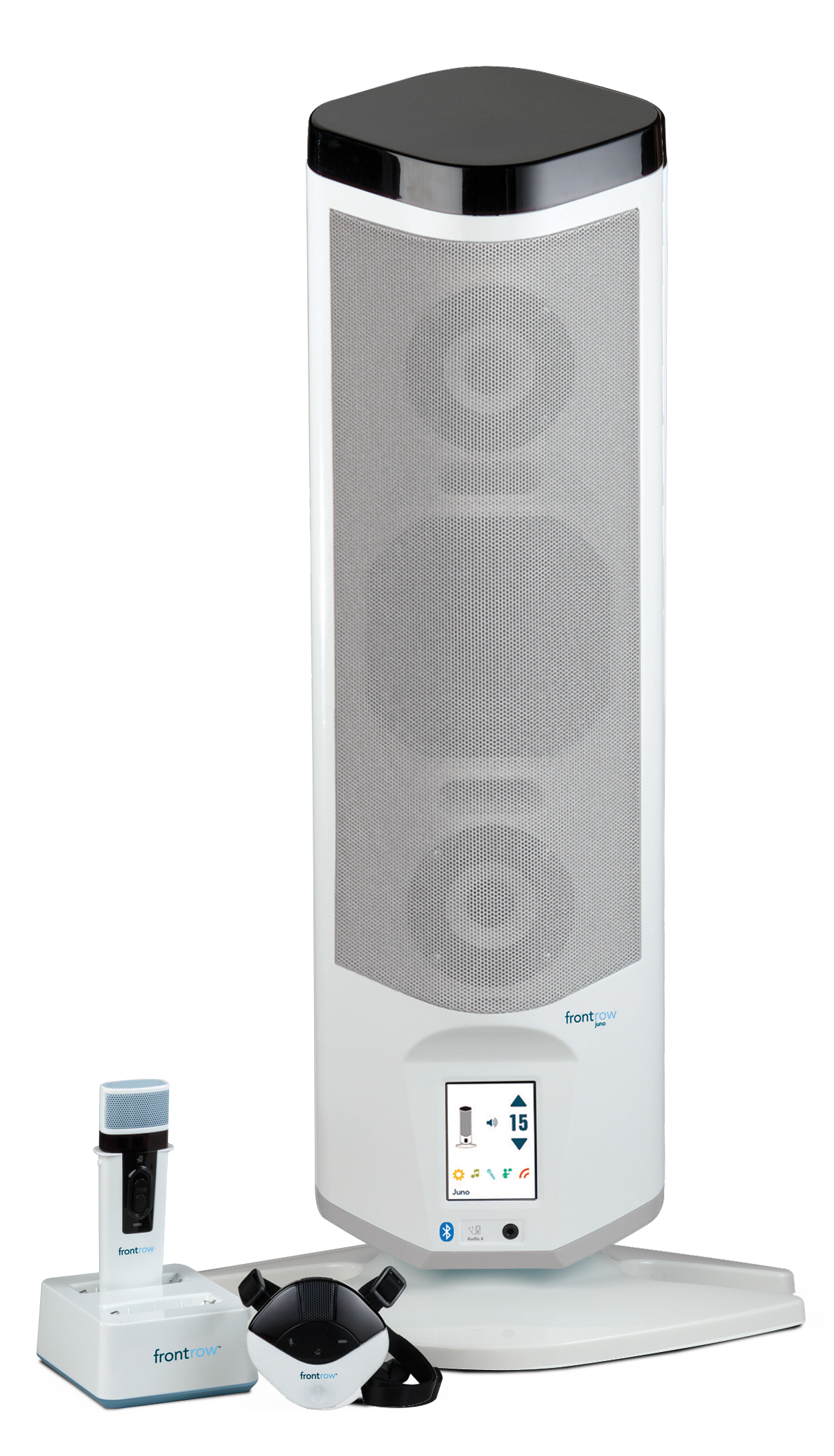 | All-in-One FrontRow JunoCompact, wall-mounted speaker with built-in amplification, OptiVoice speech optimization, Adapto feedback suppression, and SonicSuffusion™ extended projection. No ceiling installation required — ideal for standard classrooms and rapid deployments. Student microphones available for active participation. Upgrade to Juno Connect for campus communication through Symphony. |
Flexible/retrofit FrontRow UNITYUnifies classroom audio, instructional technology control, and campus communication in a single compact device. Powered by ELEVATE with the full enhanced smart technology suite — OptiVoice+, Adapto+, PrioriTeach+, PrivaSee, AnyWear, and Solo mode. The Action! teacher microphone adds programmable buttons for one-touch safety protocols and AV control. Connects natively to Symphony for bells, paging, intercom, and emergency notification. | _main_lg_col3_hpad0_x2.webp) |
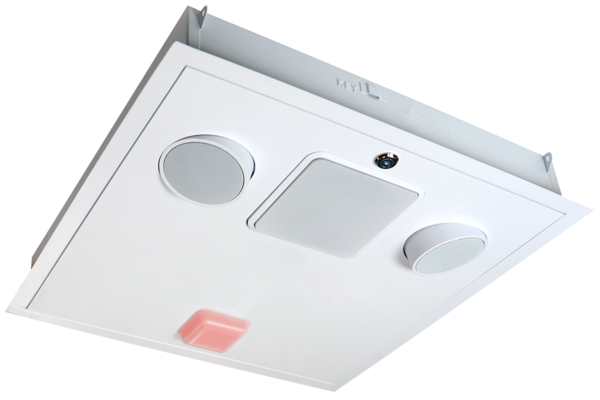 | Installed FrontRow ezRoomFully customizable, installed classroom AV solution that combines FrontRow audio, display integration, and media control in a pre-wired, pre-configured package. ELEVATE-powered with the Action! teacher microphone and the full enhanced smart technology suite. Teachers control instructional technology from a single interface. Connects natively to Symphony for campus-wide communication. Off-the-shelf pricing despite custom configuration. |
Portable FrontRow LyrikLightweight, portable PA system with Bluetooth connectivity and an 8-hour rechargeable battery. PrioriTeach automatic audio ducking ensures the teacher's voice cuts through media playback. Lyrik brings classroom-quality audio to gymnasiums, cafeterias, outdoor events, and temporary classrooms. Pick it up, turn it on, and teach. | 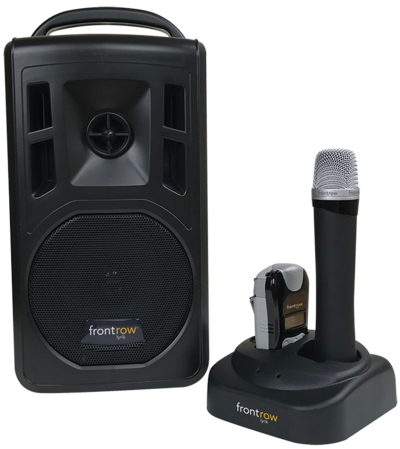 |
Buying Guide Evaluating Classroom Audio Systems?The Classroom Audio System Buying Guide covers speaker types, microphone options, integration requirements, and evaluation criteria for K–12 environments. | Read the Guide |
Accessibility & Equity
Access and Equity Are in the DNA
FrontRow was founded in 1963 by Speech-Language Pathologist Ruth Holden, who understood that students with hearing challenges were being left behind not because of ability, but because of audibility. That founding commitment — ensuring every learner can hear and participate — still drives every product powered by FrontRow technology. Every FrontRow classroom audio system ships ALD-ready as standard. Students who use hearing aids, cochlear implants, or FM receivers connect directly to the audio system. Sound support reaches all learners as a baseline environmental condition — not a special request, not a visible accommodation, and not an add-on that requires a separate purchase order. | 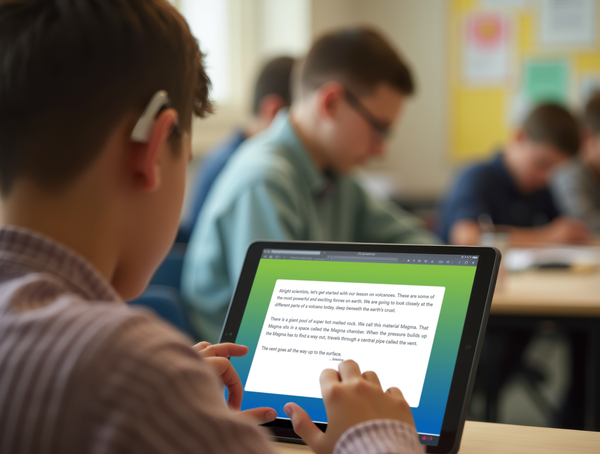 Supporting young learners with hearing challenges is in the FrontRow by Boxlight DNA, thanks to its original founder, who pioneered the space over 60 years ago. |
FrontRow Live
Real-time captions and translation in over 80 languages, displayed on interactive panels or student devices — no additional hardware required. The teacher's spoken instruction converts to on-screen text as it happens. Multilingual learners follow along in their native language. Students with hearing challenges read captions in real time. Audio distribution and visual captioning work together to reach every student through both channels. | 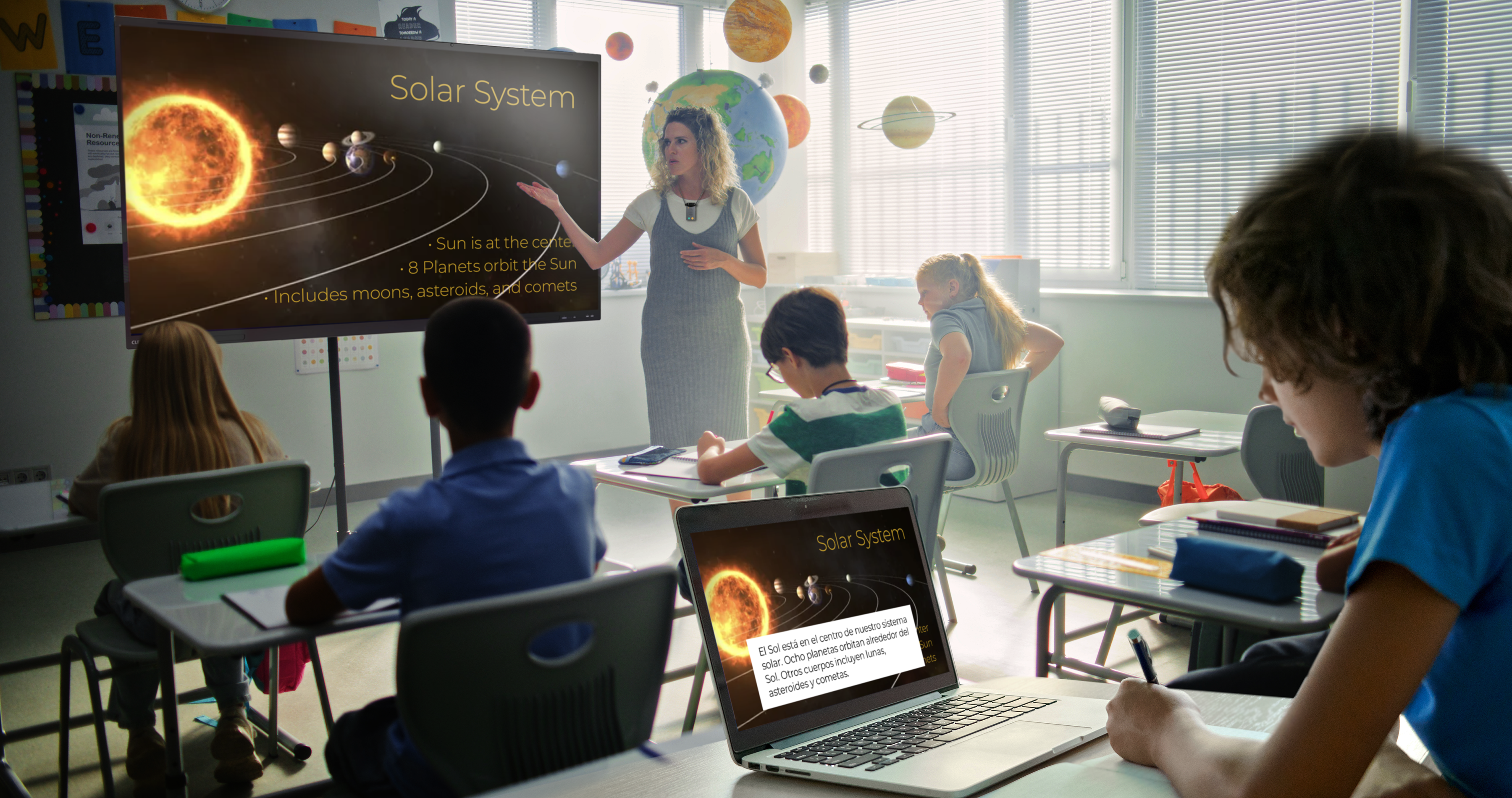 |
Beyond the Classroom
The Classroom Is the Starting Point, Not the BoundaryFrontRow audio systems connect into a broader campus communication network through Symphony. Classroom speakers become endpoints for bells, paging, intercom, and emergency notification — managed from a centralized interface across an entire building or district. The ATTENTION! ecosystem adds visual alerting through interactive displays, digital signage, and mobile devices — so emergency communication reaches every person through both audio and visual channels simultaneously.
|  |
Funding Opportunity
Need Help Securing Funding?
The Boxlight Grants Assistance Program provides free, personalized support to help districts identify, plan, and apply for federal and state funding — including E-Rate, Title IV-A, COPS SVPP, and Alyssa's Law programs. Classroom audio and campus communication systems qualify under multiple grant categories.
Connect with a Specialist
Whether you need classroom audio for a single building or a district-wide communication infrastructure, our team can help you evaluate options, plan deployment, and identify funding sources.
Frequently Asked Questions
What is a classroom audio distribution system?
A classroom audio distribution system, also called a soundfield or voice lift system, distributes a teacher's voice evenly throughout a room so all students hear instruction clearly regardless of seating position, room acoustics, or background noise. The teacher wears a wireless microphone, and speakers deliver amplified sound to every listening position.
Why do classrooms need audio amplification?
Children's auditory processing systems are not fully developed until approximately age 13, and younger students lack the vocabulary and contextual experience to fill in missed words. Research shows that students in the back of a classroom can miss up to 40% of spoken instruction. Background noise from HVAC systems, hallway traffic, and student movement compounds the problem. Audio amplification standardizes the listening experience for every student.
What does the research say about classroom audio and student outcomes?
Classroom audio is one of the most research-backed investments in education technology. The landmark MARRS study demonstrated improved reading, language, and math scores. Students receiving phonemic instruction in amplified classrooms score significantly higher on phonological awareness assessments. Research consistently documents increased participation, improved on-task behavior, and reduced special education referral rates. Teacher absences related to vocal strain also decline substantially in amplified classrooms.
Who benefits from classroom audio systems?
Every student in the room benefits from even sound distribution. English learners need clear amplification to absorb language nuances. Students with auditory processing challenges require distortion-free sound. Neurodiverse learners engage more effectively when audio is predictable. Students with hearing aids or cochlear implants connect directly through assistive listening integration. Teachers benefit through reduced vocal strain and fatigue.
What is the difference between FrontRow Juno, UNITY, ezRoom, and Lyrik?
Juno is a compact, wall-mounted all-in-one speaker system for standard classrooms and quick installations. UNITY adds ELEVATE audio processing, instructional technology control, campus communication through Symphony, and the Action! teacher microphone with programmable safety buttons. ezRoom is a fully customizable, pre-wired installed solution combining audio, display integration, and AV control into a single classroom endpoint. Lyrik is a portable PA system with an 8-hour battery for gymnasiums, events, and temporary spaces.
What are FrontRow Smart Technologies?
FrontRow Smart Technologies are proprietary audio processing features built specifically for K–12 classroom environments. They include OptiVoice for speech intelligibility, Adapto for feedback suppression, PrioriTeach for automatic teacher voice priority, and SonicSuffusion for extended sound projection. ELEVATE-powered systems like UNITY and ezRoom include enhanced versions alongside PrivaSee, AnyWear, and Solo mode.
Do FrontRow systems support assistive listening devices?
Yes. Every FrontRow classroom audio system is assistive listening device-ready. Students who use personal hearing aids, cochlear implants, or FM receivers connect directly to the audio system. Sound support reaches all students as a baseline environmental condition rather than a visible accommodation.
Can FrontRow audio systems connect to campus paging and emergency notification?
Yes. UNITY and ezRoom connect natively to Boxlight Symphony for campus-wide bells, paging, intercom, and emergency notification. Juno Connect also integrates with Symphony. The same speakers that deliver instruction during the day carry alerts when needed. Symphony manages these functions across an entire building or district from a centralized interface.
What is FrontRow Live?
FrontRow Live provides real-time captioning and translation in over 80 languages, displayed on interactive panels or student devices. It converts the teacher's spoken instruction into on-screen text without requiring additional hardware. Audio distribution and visual captioning work together to reach every student through both channels.
How does classroom audio reduce teacher vocal strain?
Teachers speak at a conversational volume while the system distributes their voice across the room, eliminating the need to project or repeat instructions throughout the day. The MARRS study documented a dramatic reduction in teacher absences related to vocal fatigue in amplified classrooms.
Do classroom audio systems support remote and hybrid learning?
FrontRow systems integrate with Zoom, Microsoft Teams, Google Meet, and other videoconferencing platforms. The microphone that distributes the teacher's voice locally also captures it for remote participants. Students attending virtually hear instruction with the same clarity as those in the classroom.
Related Resources
Buying Guide Classroom Audio System Buying Guide for K–12 SchoolsSpeaker types, microphone options, and evaluation criteria. | Foundations Classroom Audio Distribution Systems (CADs)Why audibility is the condition on which every instructional system depends. | Buying Guide Campus Communication System Buying GuidePaging, bells, intercom, and emergency notification evaluation. |